Erectile Dysfunction • PDE5 Inhibitor

Sildenafil vs Viagra: Brand Quality, Onset & Clinical Performance

Sildenafil and Viagra share the same active molecule, yet their real‑world performance can differ due to formulation quality, excipients, and manufacturing standards. Branded Viagra offers highly consistent pharmacokinetics, while generics vary in absorption and onset, which can influence reliability during sexual activity. Many patients report comparable effectiveness, but tolerability and timing can shift depending on the specific generic chosen. Understanding how these variations arise is essential when evaluating sildenafil generics, comparing manufacturing brand quality, or selecting the most appropriate dose for stable response. This overview helps clarify how brand vs generic differences translate into onset predictability, vascular action, and overall user experience.

Sildenafil vs Viagra: Brand and Generic Comparison
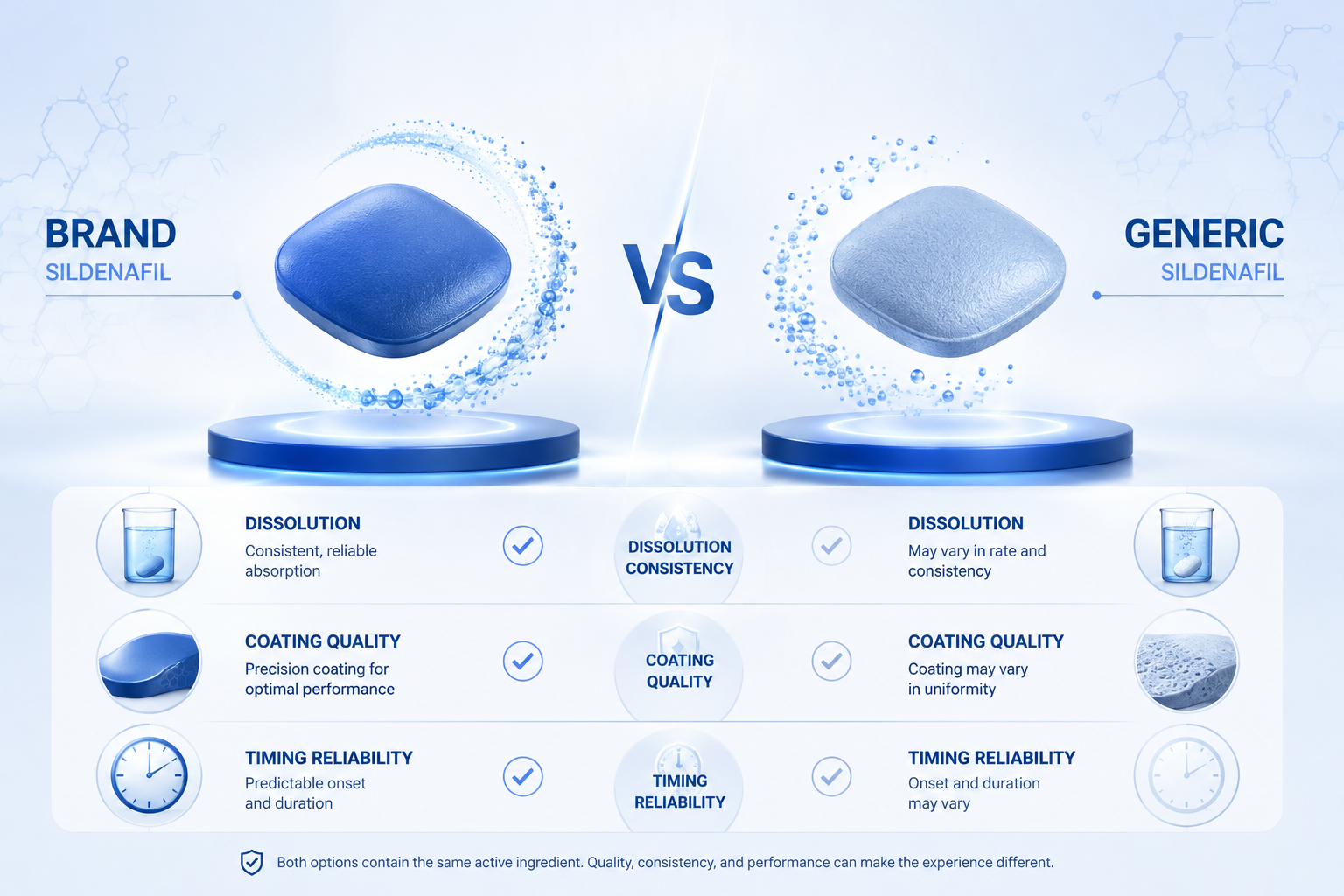
Sildenafil vs Viagra

Viagra is the original branded formulation of sildenafil, developed with tightly controlled manufacturing standards and consistent pharmacokinetic behavior. Sildenafil, in contrast, refers to the generic versions produced after patent expiry, all of which must meet strict regulatory bioequivalence criteria. These requirements ensure that generics deliver the same active ingredient, comparable plasma concentrations, and equivalent therapeutic effect, even though excipients, tablet hardness, and dissolution profiles may differ across manufacturers. Patients exploring sildenafil generics often encounter variations in onset reliability and tolerability, not because the molecule changes, but due to formulation‑specific differences that can influence absorption dynamics.

Generics exist to expand access and reduce cost while maintaining clinical equivalence to the branded product. For most users, effectiveness remains similar, with predictable PDE5 inhibition and adequate vascular response. However, some individuals perceive subtle differences in timing or gastrointestinal tolerability depending on the specific generic chosen. Understanding how regulatory standards shape generic quality helps clarify why Viagra maintains a reputation for consistency, yet well‑produced generics remain a clinically valid and widely used alternative. This overview provides a structured foundation for comparing branded Viagra with its generic counterparts and evaluating real‑world performance across formulations.

Brand vs Generic Sildenafil Differences

Viagra and generic sildenafil contain the exact same active ingredient, ensuring identical PDE5 inhibition and equivalent therapeutic potential. The differences arise from non‑active components: excipients, coatings, granulation methods, and tablet compression. These formulation variables influence dissolution speed and absorption consistency, which explains why some users perceive faster or smoother onset with the branded version. Manufacturing standards also vary across generic producers, creating subtle differences in tolerability, especially in individuals sensitive to gastrointestinal excipients. Patients comparing branded and generic options often review brand quality to understand how production controls affect real‑world performance.

Price and availability represent the most visible distinctions. Viagra remains a premium product with higher cost due to brand recognition and manufacturing uniformity, while generics offer broad accessibility at significantly lower prices. Despite these economic differences, clinical outcomes remain comparable for most users. Variability in perceived onset or smoothness typically reflects formulation‑specific factors rather than pharmacological differences. Understanding these nuances helps patients make informed decisions when choosing between branded Viagra and generic sildenafil.

Factor Viagra (Brand) Sildenafil (Generic)
Active ingredient Identical Identical
Excipients Proprietary Varies by manufacturer
Dissolution Highly consistent Brand‑dependent
Price High Low

Effectiveness of Viagra vs Generic Sildenafil

Regulatory bioequivalence standards ensure that Viagra and generic sildenafil deliver comparable effectiveness, producing similar improvements in erectile function across patient groups. Because the active ingredient and plasma exposure requirements are identical, both options achieve the same therapeutic endpoint. However, excipient differences can influence dissolution speed, which may slightly alter onset perception. Some users report that certain generics feel slower or less predictable, not due to weaker pharmacology but because formulation variability affects how quickly the tablet breaks down in the gastrointestinal tract.

Real‑world timing reliability can therefore vary across generic manufacturers. While Viagra offers highly consistent onset and tolerability, generics range from equally reliable to moderately variable depending on excipient blends and coating thickness. These nuances matter for patients who require precise timing or who experience sensitivity to formulation differences. Reviewing strategies in maximize effectiveness can help optimize results regardless of whether a branded or generic option is used.

Factor Viagra Generic Sildenafil
Overall effectiveness High High
Timing reliability High Moderate–high
Food sensitivity High High

Onset & Duration: Viagra vs Generic Sildenafil

Viagra and generic sildenafil share identical pharmacokinetic parameters: onset typically occurs within 30–60 minutes, and duration lasts approximately 4–6 hours. These values reflect the inherent properties of sildenafil citrate and remain consistent across branded and generic formulations. However, some users perceive certain generics as slightly slower. This effect is usually linked to tablet coatings or excipient blends that delay dissolution, especially when taken with food. Such differences do not alter the underlying pharmacology but can influence practical timing during sexual activity.

For most patients, onset and duration remain clinically equivalent across all sildenafil products. Those requiring highly predictable timing may prefer formulations with minimal coating or proven dissolution consistency. Practical timing guidance and detailed pharmacokinetic expectations are covered in the Onset & Duration section, helping users align dosing with planned sexual activity and minimize variability.

Medication Onset Duration Notes
Viagra 30–60 min 4–6 hours Highly consistent
Generic sildenafil 30–60 min 4–6 hours Brand‑dependent variability

Side Effects: Viagra vs Generic Sildenafil

Viagra and generic sildenafil share the same active ingredient, which means their core side‑effect profile is fundamentally identical. Typical reactions such as headache, facial flushing, and nasal congestion arise from sildenafil’s vasodilatory mechanism and occur at similar rates across all formulations. However, differences in excipients, coatings, and tablet binders can influence tolerability for sensitive users. Some individuals report smoother gastrointestinal comfort or fewer transient sensations with the branded product, while others tolerate generics equally well. These variations do not reflect changes in pharmacology but rather formulation‑specific factors that may affect dissolution speed or local GI irritation.

In practical use, most patients experience comparable tolerability regardless of whether they choose Viagra or a generic alternative. Those who notice differences often benefit from reviewing formulation details or exploring options discussed in the Side Effects section. Understanding how excipients contribute to minor variations helps clarify why side effects remain consistent overall, yet individual experiences can differ slightly across manufacturers.

Side Effect Viagra Generic Sildenafil
Headache Common Common
Flushing Common Common
Nasal congestion Common Common
Visual tint Possible Possible

Practical Use Differences Between Viagra and Generic Sildenafil

Practical distinctions between Viagra and generic sildenafil often revolve around consistency, availability, and user expectations rather than pharmacological differences. Viagra may suit patients who prioritize predictable onset, uniform tablet quality, and long‑standing brand trust. Its manufacturing controls help ensure stable dissolution and tolerability, which can be valuable for individuals who require highly reliable timing during sexual activity. Conversely, generic sildenafil fits users seeking cost‑effective therapy with broad availability across pharmacies and online providers. Generics offer the same active ingredient at significantly lower prices, making them accessible for long‑term use.

Timing flexibility is similar across both options, though minor variability in coatings or excipient blends can influence how quickly certain generics dissolve. Patients who notice differences may benefit from exploring alternative manufacturers or adjusting timing strategies discussed in dose selection. Ultimately, Viagra provides consistency and brand assurance, while generics deliver affordability and wide distribution. Understanding these practical nuances helps users choose the formulation that aligns best with their expectations, budget, and timing needs.

Frequently Asked Questions

Viagra and generic sildenafil contain the same active ingredient, so their clinical effectiveness is generally equivalent. Most users achieve similar improvements in erectile function with either option. Perceived differences often come from formulation factors such as excipients or coating, which can influence how quickly the tablet dissolves. These variations may affect subjective impressions of onset or smoothness, but the underlying pharmacological effect remains the same across both branded and generic products.

Some users prefer Viagra because of its long‑standing brand reputation, consistent manufacturing standards, and predictable dissolution profile. These factors can create a sense of reliability, especially for individuals who value highly consistent timing. Others appreciate the uniform tablet quality and tolerability associated with the branded product. While generics perform similarly, personal experience, trust, and perceived stability often influence why certain users continue to choose Viagra over lower‑cost alternatives.

Yes, generics work the same as Viagra in terms of pharmacological action and therapeutic outcome. Regulatory bioequivalence standards require generics to match the branded product in active ingredient, absorption profile, and overall effect. Differences may arise from excipients or coating, which can influence onset perception or tolerability for some individuals. However, the core mechanism and expected clinical benefit remain consistent across both branded Viagra and generic sildenafil.

Side effects are generally identical because both Viagra and generic sildenafil use the same active ingredient. Common reactions such as headache, flushing, and nasal congestion occur at similar rates. Minor differences may be noticed by users sensitive to specific excipients or coatings, which can influence gastrointestinal comfort or dissolution speed. These variations do not change the core safety profile but may affect how certain individuals perceive tolerability across different formulations.

The pharmacological onset is the same for both Viagra and generic sildenafil, typically occurring within 30–60 minutes. Some users perceive certain generics as slightly slower due to differences in excipients or coating thickness, which can influence how quickly the tablet dissolves. These variations do not affect the underlying mechanism but may create subtle differences in timing reliability. For most users, onset remains clinically equivalent across all sildenafil formulations.

Viagra is more expensive because it is the original branded product with strong market recognition, consistent manufacturing controls, and established global distribution. Brand value, marketing, and proprietary formulation standards contribute to its higher price. Generic sildenafil is produced by multiple manufacturers after patent expiry, which increases competition and lowers cost. Despite the price difference, generics must meet strict regulatory requirements to ensure equivalent therapeutic performance.

Choosing between Viagra and generic sildenafil depends on priorities such as consistency, cost, availability, and personal tolerability. Viagra may suit users who value predictable timing and brand assurance, while generics offer a more affordable option with similar effectiveness. Some individuals experiment with different generic manufacturers to find the formulation that feels most comfortable. Considering factors like budget, timing needs, and past experiences can help determine which option aligns best with individual expectations.