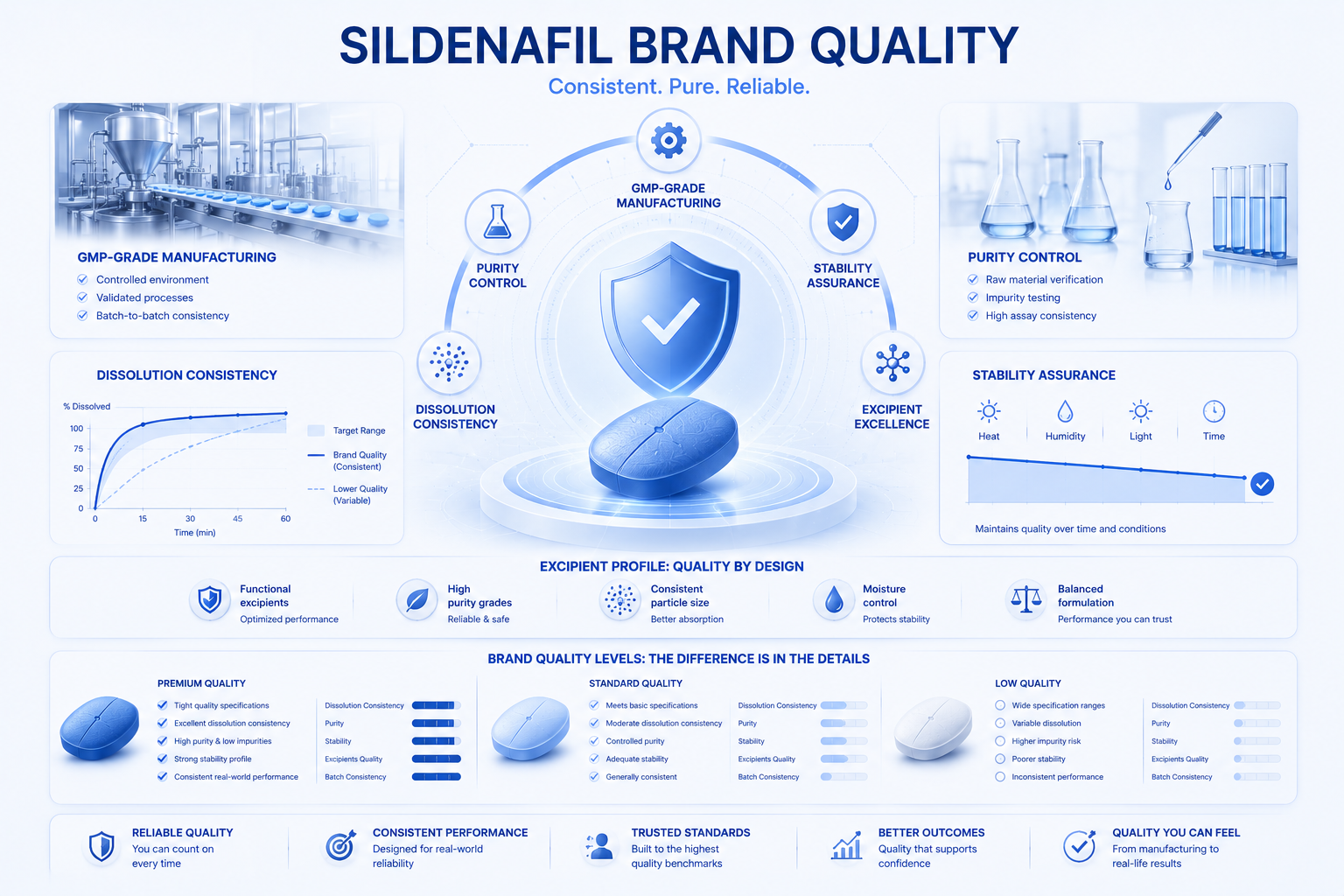
Sildenafil brand quality directly influences how predictably the medication dissolves, absorbs, and maintains stability over time. GMP‑certified manufacturers ensure tighter control over excipients, particle size, and tablet hardness — all factors that shape onset reliability and overall therapeutic consistency. Because generic formulations vary, patients often notice differences in smoothness of effect, tolerability, and duration when switching brands. Understanding these variations helps clarify why some generics perform closer to premium reference products. Explore how generics differ in the Generics section, compare dissolution and stability profiles in Brand Comparison, and review how branded Viagra aligns with high‑grade manufacturing in Sildenafil vs Viagra.
Sildenafil brand quality reflects how consistently a manufacturer can deliver a tablet that dissolves, absorbs, and maintains stability according to GMP standards. Although all approved products contain the same active ingredient, differences in excipients, granulation methods, coating materials, and dissolution profiles create meaningful variability in how the drug behaves once taken. These manufacturing‑level factors determine how quickly sildenafil reaches effective plasma levels, how predictable the onset feels, and how smoothly the vascular response unfolds — aspects closely tied to core pharmacokinetics.
GMP‑compliant brands typically show tighter batch‑to‑batch uniformity, resulting in more reliable onset and fewer fluctuations in tolerability. In contrast, brands with broader manufacturing tolerances may produce tablets that dissolve slower or faster than expected, leading some patients to perceive them as “stronger,” “weaker,” or less stable across repeated use. These subjective differences often stem from excipient composition, tablet hardness, and coating integrity rather than the sildenafil molecule itself.
Understanding brand quality helps explain why two generics with identical labeled doses can feel noticeably different in real‑world use. Evaluating dissolution consistency, excipient profiles, and manufacturing precision provides a clearer picture of how each brand performs and why stability matters for achieving predictable therapeutic results.
Good Manufacturing Practice (GMP) defines the regulatory framework that ensures every sildenafil tablet is produced under strict quality‑control conditions. GMP certification requires manufacturers to follow validated procedures for granulation, blending, compression, coating, and packaging, guaranteeing that each batch maintains consistent purity, dissolution behavior, and long‑term stability. These standards directly influence how reliably sildenafil reaches therapeutic plasma levels and how predictable the clinical effect feels across repeated doses. Users comparing brands often notice smoother onset and fewer tolerability fluctuations when switching from non‑certified products to GMP‑compliant ones, largely due to tighter control over excipients and dissolution kinetics, which are central to real‑world performance and can be further explored in Brand Comparison.
Non‑GMP manufacturers may still meet basic regulatory requirements, but their production tolerances are broader, leading to variability in tablet hardness, impurity levels, and moisture sensitivity. This inconsistency can cause tablets to dissolve faster or slower than intended, resulting in noticeable differences in onset strength, duration, and overall smoothness of effect. For users, choosing a GMP‑certified brand means more predictable outcomes, fewer surprises between batches, and greater confidence that the medication performs as labeled. In contrast, non‑certified products may feel inconsistent, especially for individuals sensitive to excipient changes or dissolution variability.
| Factor | GMP Brand | Non‑GMP Brand |
|---|---|---|
| Quality control | High | Variable |
| Dissolution consistency | Reliable | Unpredictable |
| Stability | High | Variable |
| Impurity levels | Strictly controlled | May vary |
Brand stability describes how well a sildenafil formulation maintains potency, dissolution behavior, and structural integrity over time. Stability is influenced by coating quality, excipient selection, packaging materials, and environmental resistance to humidity and temperature. High‑stability brands use protective film coatings, moisture‑resistant excipients, and sealed blister packaging that preserves tablet hardness and prevents premature degradation. These factors determine how reliably sildenafil performs throughout its shelf life and help explain why some generics behave more consistently than others. Users exploring differences across formulations can review broader generic variability in the Generics section.
Low‑stability brands may degrade faster due to weaker coatings, porous packaging, or excipients that absorb moisture. As tablets soften or lose structural uniformity, dissolution becomes less predictable, leading to fluctuations in onset timing and perceived potency. Environmental exposure — especially high humidity or heat — accelerates degradation, making proper storage essential. Keeping sildenafil in its original blister pack, away from bathrooms or warm areas, helps maintain stability and ensures the medication performs as intended. For users who notice inconsistent effects between doses, brand stability is often the underlying factor rather than the active ingredient itself.
| Factor | High‑Stability Brand | Low‑Stability Brand |
|---|---|---|
| Coating quality | Strong | Weak |
| Packaging | Protective | Basic |
| Humidity resistance | High | Low |
| Shelf life | Long | Shorter |
Dissolution rate is one of the most critical determinants of how quickly sildenafil begins to work. Once the tablet enters the stomach, its ability to break apart and release the active ingredient dictates how rapidly absorption can occur. Brands with optimized excipient blends and high‑quality coatings typically dissolve faster, producing a more predictable onset and smoother vascular response. In contrast, slower‑dissolving formulations may delay absorption, causing onset variability that users often interpret as weaker or inconsistent. These differences are especially relevant for individuals who rely on precise timing and can be further explored in the Timing Optimization section.
Excipients such as disintegrants, binders, and lubricants influence how efficiently the tablet disperses in gastric fluid. Premium GMP brands use excipient systems designed for uniform disintegration, while low‑cost generics may rely on simpler formulations that behave unpredictably. As a result, onset reliability varies significantly across the market. For users, understanding dissolution behavior helps determine when to take sildenafil relative to sexual activity and whether switching brands may improve timing consistency. Faster‑dissolving products generally suit those who prefer shorter lead times, while moderate or variable dissolution may require earlier dosing.
| Brand Type | Dissolution Speed | Onset Reliability | Notes |
|---|---|---|---|
| Premium GMP | Fast | High | Consistent excipients |
| Standard generic | Moderate | Moderate | Brand‑dependent |
| Low‑cost generic | Variable | Low | Inconsistent coating |
Evaluating sildenafil brand quality involves assessing manufacturing standards, dissolution performance, stability data, and packaging integrity. GMP certification remains the strongest indicator of reliability, ensuring that each batch meets strict requirements for purity, tablet hardness, and disintegration behavior. Manufacturer reputation also plays a major role, as brands with long‑standing quality control systems typically deliver more predictable onset and tolerability. Users comparing multiple options can review structural differences in the Brand Comparison section.
Dissolution consistency is another essential criterion. High‑quality brands publish validated dissolution test results demonstrating uniform disintegration across batches, while lower‑quality manufacturers may show variability that affects onset timing. Packaging quality further influences stability: protective blister packs preserve moisture resistance and prevent degradation, whereas basic packaging may expose tablets to humidity and temperature fluctuations. By evaluating these factors together — GMP status, dissolution data, stability, and packaging — users can identify brands that deliver reliable therapeutic performance and avoid those prone to inconsistency.
| Criterion | High‑Quality Brand | Low‑Quality Brand |
|---|---|---|
| GMP certification | Yes | No |
| Dissolution tests | Consistent | Variable |
| Packaging | Protective | Basic |
| Stability | High | Low |
Significant variability in onset, unusual side effects, or visible tablet defects can indicate deeper manufacturing or stability problems rather than normal brand‑to‑brand differences. When dissolution becomes unpredictable — for example, onset fluctuates widely between doses — the issue may stem from inconsistent excipients, poor coating integrity, or degradation caused by inadequate packaging. Users experiencing unexpected reactions should review broader safety considerations in the Side Effects section, especially if symptoms differ from typical PDE5 inhibitor profiles.
Physical changes such as crumbling, softening, or discoloration often signal moisture exposure or substandard stability controls. These defects reduce potency and can alter absorption, making the medication feel weaker or erratic. In such cases, switching to a higher‑quality or GMP‑certified brand is advisable. If adverse reactions persist or escalate, users should also consult the Warnings section to determine whether additional medical evaluation is warranted. Ultimately, persistent quality issues suggest that the brand may not meet necessary manufacturing standards, and transitioning to a more reliable product can restore predictable therapeutic performance.
Sildenafil brand quality determines how consistently a tablet dissolves, absorbs, and maintains its intended potency. Even though all brands contain the same active ingredient, differences in manufacturing precision, excipients, and stability controls can influence onset timing and overall tolerability. High‑quality brands typically provide smoother, more predictable effects, while lower quality products may feel inconsistent between doses. For users who rely on reliable timing and stable performance, brand quality becomes a key factor in real‑world effectiveness.
GMP‑certified brands follow strict manufacturing standards that ensure consistent purity, tablet hardness, dissolution behavior, and stability across batches. This results in more predictable onset and fewer fluctuations in how the medication feels from one dose to another. Non‑GMP brands may still meet basic regulatory requirements, but their production tolerances are broader, which can lead to variability in performance. For most users, GMP products provide a more dependable therapeutic experience.
Perceived strength differences usually come from variations in dissolution speed, excipient composition, and coating quality rather than differences in the sildenafil molecule itself. Faster dissolving brands may produce a quicker, more noticeable onset, while slower or inconsistent formulations can feel weaker or delayed. Stability also plays a role: degraded tablets may lose potency and behave unpredictably. These factors explain why two generics with the same labeled dose can feel different in practice.
Yes. Excipients such as disintegrants, binders, and lubricants determine how quickly a tablet breaks apart in the stomach and releases the active ingredient. High‑quality excipient systems promote uniform disintegration and faster absorption, leading to more reliable onset. Lower‑quality or inconsistent excipients can slow dissolution or cause variability between doses. Because excipients differ across manufacturers, they are a major reason why onset timing varies from brand to brand.
High‑quality brands typically demonstrate GMP certification, consistent dissolution test results, strong stability data, and protective packaging that prevents moisture exposure. Users often notice predictable onset, stable tolerability, and uniform tablet appearance. In contrast, lower‑quality brands may show variability between batches, weaker coatings, or tablets that degrade faster. While packaging and manufacturer reputation offer clues, real‑world consistency is often the clearest indicator of quality.
Stability differences arise from variations in coating integrity, excipient moisture resistance, packaging quality, and overall manufacturing controls. Some generics use simpler or less protective formulations that degrade faster when exposed to humidity or heat. As tablets soften or lose structural uniformity, dissolution becomes less predictable, affecting onset and potency. Brands with stronger coatings and sealed blister packaging generally maintain stability far better over time.
Switching brands may be appropriate when onset becomes inconsistent, tablets show signs of degradation, or side effects differ noticeably from previous experiences. Variability in performance often indicates manufacturing or stability issues rather than changes in your response to sildenafil. If a brand feels unreliable across multiple doses, moving to a GMP‑certified or higher‑stability product can restore predictable results. Persistent problems may warrant discussing alternatives with a healthcare professional.