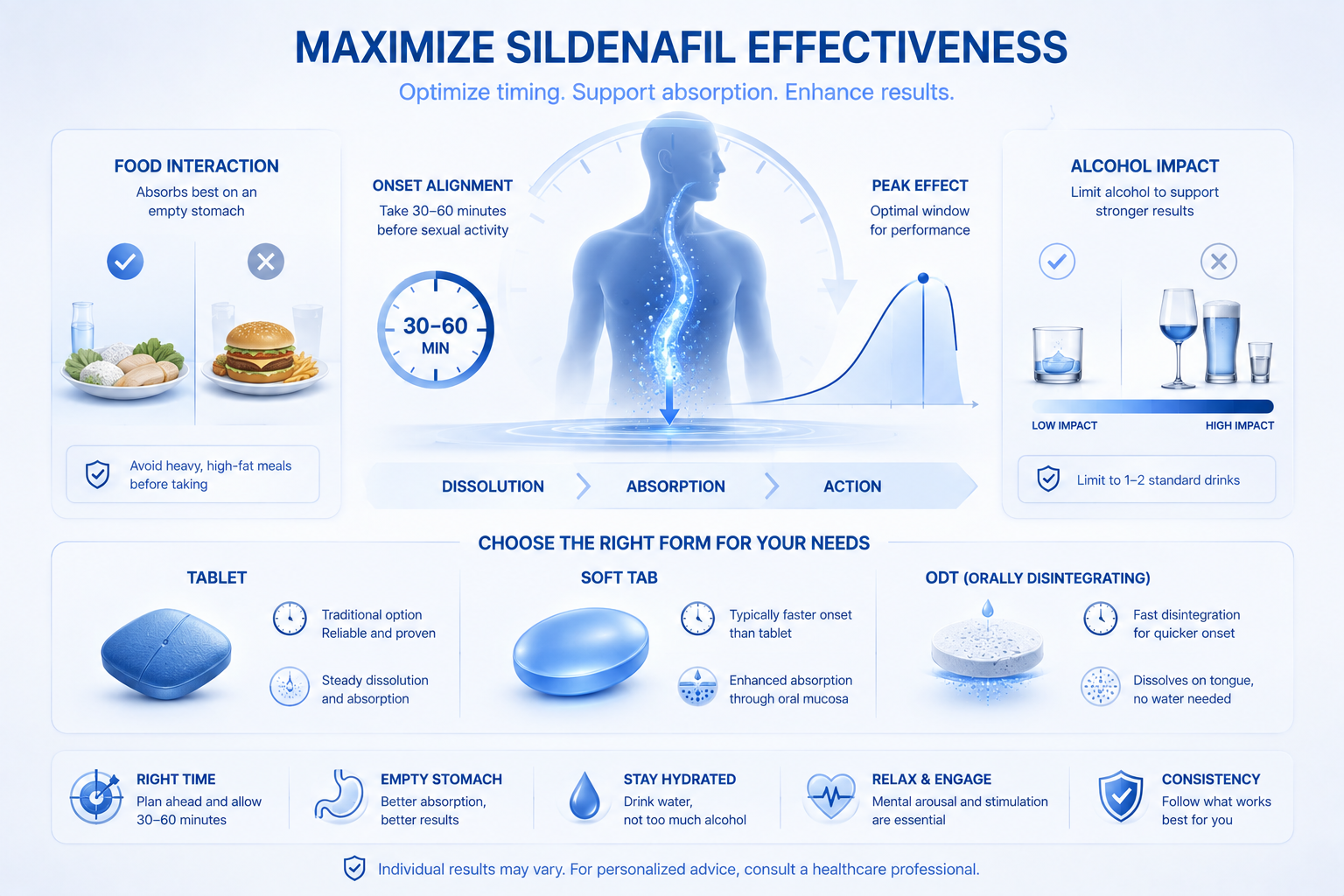
Sildenafil’s effectiveness depends heavily on timing, food intake, formulation choice, and how consistently users avoid common mistakes. Its vascular response is strongest when taken with proper timing, which you can refine in the Timing Optimization guide. A high‑fat meal may delay onset and reduce peak absorption, making dietary awareness essential — see detailed insights in Food Interactions. Effectiveness also varies between tablets and ODT forms, especially for men seeking faster onset or more predictable action. Many users lose efficacy due to avoidable behavioral errors, explored in Common Mistakes, helping you achieve a more reliable therapeutic window.
Sildenafil’s effectiveness reflects how fully its PDE5‑inhibition translates into improved penile blood flow during sexual stimulation. While the drug can “work” in a basic sense by enhancing nitric‑oxide signaling, true optimal performance depends on how efficiently it reaches and maintains therapeutic plasma levels — a process shaped by its underlying pharmacokinetics. The distinction between a dose that merely produces some response and one that delivers maximal rigidity, duration, and reliability is central to understanding effectiveness.
Multiple external factors influence this therapeutic window. Timing determines whether sildenafil’s onset aligns with sexual activity, and even small deviations can reduce perceived efficacy. Food, especially high‑fat meals, slows gastric emptying and delays absorption, while alcohol may blunt vascular responsiveness and impair erection quality. Dose selection also matters: insufficient dosing may produce partial results, whereas higher doses increase both potency and the risk of adverse effects. Formulation differences — such as standard tablets versus ODT variants — further affect onset speed and consistency.
Ultimately, sildenafil’s effectiveness is not binary. It is a spectrum shaped by user behavior, physiological variables, and formulation characteristics. When timing, diet, alcohol intake, and dose are aligned correctly, the drug’s pharmacodynamic action becomes more predictable, allowing men to achieve the optimal response rather than a merely adequate one.
Sildenafil’s timing window is one of the strongest determinants of how effectively the medication supports erectile function. Most men experience onset within 30–60 minutes, but this range varies depending on formulation, gastric emptying, and individual pharmacokinetic factors. Taking the medication too early may cause the effect to fade before sexual activity begins, while taking it too late can result in missing the peak window entirely. Aligning onset with planned activity is therefore essential, and practical strategies are outlined in the Timing Optimization section.
Formulation differences also influence timing reliability. Standard tablets rely on gastrointestinal absorption, making their onset more sensitive to food and individual variability. Soft tabs dissolve partially through buccal absorption, offering a faster and more predictable onset. Orally disintegrating tablets (ODT) provide the quickest activation because they bypass most GI delays. Choosing the right form helps ensure that sildenafil reaches its active phase precisely when needed.
| Form | Typical Onset | Best Timing Strategy |
|---|---|---|
| Tablets | 30–60 min | Take 1 hour before |
| Soft Tabs | 20–40 min | Take 30–40 min before |
| ODT | 15–30 min | Take 15–30 min before |
Dietary and alcohol‑related factors significantly influence how quickly and how strongly sildenafil takes effect. High‑fat meals slow gastric emptying, delaying absorption and pushing onset well beyond the expected window. Light meals cause only minor delays, but still require modest timing adjustments. Alcohol, even in moderate amounts, can reduce erection quality by impairing vascular responsiveness and diminishing the physiological signals needed for optimal sildenafil action. More detailed guidance is available in the Food Interactions and Alcohol sections.
To minimize these impacts, users can adjust timing based on meal composition and alcohol intake. Waiting 1–2 hours after a heavy meal allows sildenafil to reach the bloodstream more efficiently, while a 30–45‑minute buffer after a light meal is usually sufficient. Limiting alcohol helps preserve the medication’s full therapeutic potential. These practical adjustments ensure that sildenafil’s onset aligns with planned activity and maintains predictable effectiveness.
| Factor | Impact | Optimization Tip |
|---|---|---|
| Fatty meals | Delays onset | Wait 1–2 hours |
| Light meals | Minor delay | Wait 30–45 min |
| Alcohol | Reduces effectiveness | Limit intake |
Sildenafil’s formulation plays a major role in determining onset speed, absorption pathway, and overall reliability. Standard tablets rely entirely on gastrointestinal absorption, making them more sensitive to food‑related delays. Soft tabs combine buccal and GI absorption, offering faster and more predictable activation. Orally disintegrating tablets (ODT) rely primarily on buccal absorption, bypassing most GI variability and providing the fastest onset. More detailed comparisons are available in the Soft Tabs and ODT sections.
Buccal absorption is particularly advantageous because it avoids the timing disruptions caused by heavy meals and variable gastric emptying. Men who require precise onset alignment — for example, those with planned sexual activity or inconsistent GI response — often benefit from faster forms. Selecting the right formulation ensures that sildenafil reaches its active phase consistently, improving both reliability and overall therapeutic performance.
| Form | Absorption | Timing Reliability | Notes |
|---|---|---|---|
| Tablets | GI | Moderate | Food-sensitive |
| Soft Tabs | Buccal + GI | High | Faster onset |
| ODT | Buccal | Very high | Fastest onset |
Many men experience reduced sildenafil effectiveness not because the medication fails, but because common behavioral and timing mistakes interfere with its pharmacodynamic window. One of the most frequent issues is taking the dose too close to a heavy, high‑fat meal, which significantly slows gastric emptying and delays absorption. Another mistake is mistiming the dose — taking it too early may cause the effect to fade before sexual activity, while taking it too late results in missing the peak window entirely. These patterns are explored in more detail in the Common Mistakes section.
Alcohol overuse is another major factor. Even moderate amounts can reduce erection quality by impairing vascular responsiveness and destabilizing blood pressure, making sildenafil feel less effective. Users also frequently ignore formulation differences: tablets, soft tabs, and ODT forms have distinct absorption pathways, and misunderstanding these differences leads to unpredictable onset. Finally, misinterpreting normal onset variability — expecting identical timing every use — can create the false impression that the medication is “not working,” even when pharmacokinetics are functioning normally.
| Mistake | Impact | Notes |
|---|---|---|
| Heavy meal before dosing | Delayed onset | Food-sensitive |
| Taking too early | Effect may fade | Duration 4–6 hours |
| Taking too late | Missed peak | Peak window matters |
| Alcohol overuse | Reduced erection quality | BP instability |
While most sildenafil effectiveness issues stem from timing, food intake, alcohol, or formulation choice, certain patterns suggest a deeper problem that requires attention. Severe delays — for example, onset consistently taking far longer than expected — may indicate significant interference from meals, alcohol, or gastrointestinal variability. In some cases, users experience no response despite correct timing and proper use, which may point to underlying vascular or hormonal factors rather than a medication‑related issue. Strong side effects triggered by timing mistakes, such as dizziness or blood‑pressure instability, are also warning signs that the dosing context needs reevaluation. More details on adverse reactions are available in the Side Effects and Warnings sections.
When these issues occur repeatedly, adjusting timing or switching to a different formulation may help restore predictable onset. Faster forms such as soft tabs or ODT can bypass some GI‑related delays, while more structured timing strategies reduce variability. However, persistent lack of response or escalating side effects may indicate a medical condition that requires professional evaluation. A healthcare provider can help determine whether sildenafil remains appropriate and whether alternative approaches should be considered.
Maximizing sildenafil’s effectiveness involves aligning timing, meal composition, and formulation choice with how the drug is absorbed and activated in the body. Taking it on an empty stomach or after a light meal helps ensure faster onset, while avoiding alcohol preserves vascular responsiveness. Choosing forms with quicker absorption, such as soft tabs or ODT, can improve consistency. Most importantly, taking the dose at the right time before sexual activity ensures the medication reaches its peak therapeutic window.
Food, especially high‑fat meals, can significantly delay sildenafil’s onset by slowing gastric emptying and reducing the speed at which the drug enters the bloodstream. While the medication still works, the effect may begin later than expected, which can disrupt planned timing. Light meals cause only minor delays, but heavy meals often push onset well beyond the usual window. Taking sildenafil on an empty stomach or allowing enough time after eating helps maintain predictable effectiveness.
Alcohol can reduce sildenafil’s effectiveness by impairing vascular responsiveness and weakening the physiological signals needed for a strong erection. Even moderate drinking may make the medication feel less potent, while heavier intake can cause dizziness, blood‑pressure instability, and reduced erection quality. Although sildenafil still works, alcohol often blunts its peak effect. Limiting intake around dosing helps maintain a more reliable and predictable response during sexual activity.
Soft tabs often provide faster and more predictable onset compared to standard tablets because they dissolve partially through buccal absorption. This allows the medication to bypass some gastrointestinal delays, especially those caused by heavy meals. Tablets rely entirely on GI absorption, making their timing more variable. While both forms deliver the same active ingredient, soft tabs may feel more consistent for users who need quicker activation or who frequently experience food‑related timing issues.
Timing determines whether sildenafil reaches its peak concentration at the moment sexual activity begins. Taking it too early may cause the effect to fade before it is needed, while taking it too late can result in missing the optimal window entirely. Because onset varies by formulation, meal timing, and individual absorption, aligning the dose with planned activity is essential. Proper timing ensures the medication delivers its strongest and most reliable therapeutic effect when stimulation occurs.
Common mistakes include taking sildenafil immediately after a heavy meal, which delays onset, or mistiming the dose by taking it too early or too late relative to sexual activity. Alcohol overuse can weaken erection quality, making the medication feel less effective. Ignoring formulation differences also leads to inconsistent results, since tablets, soft tabs, and ODT forms absorb differently. Misinterpreting normal onset variability may cause users to assume the drug is not working when timing is the real issue.
Onset can be optimized by taking sildenafil at the right time before sexual activity, usually allowing enough minutes for the chosen form to reach peak concentration. Avoiding heavy meals and limiting alcohol helps ensure faster absorption and stronger vascular response. Users who need more predictable timing may benefit from faster forms such as soft tabs or ODT. Consistent dosing habits and awareness of individual variability also contribute to achieving a reliable onset window.