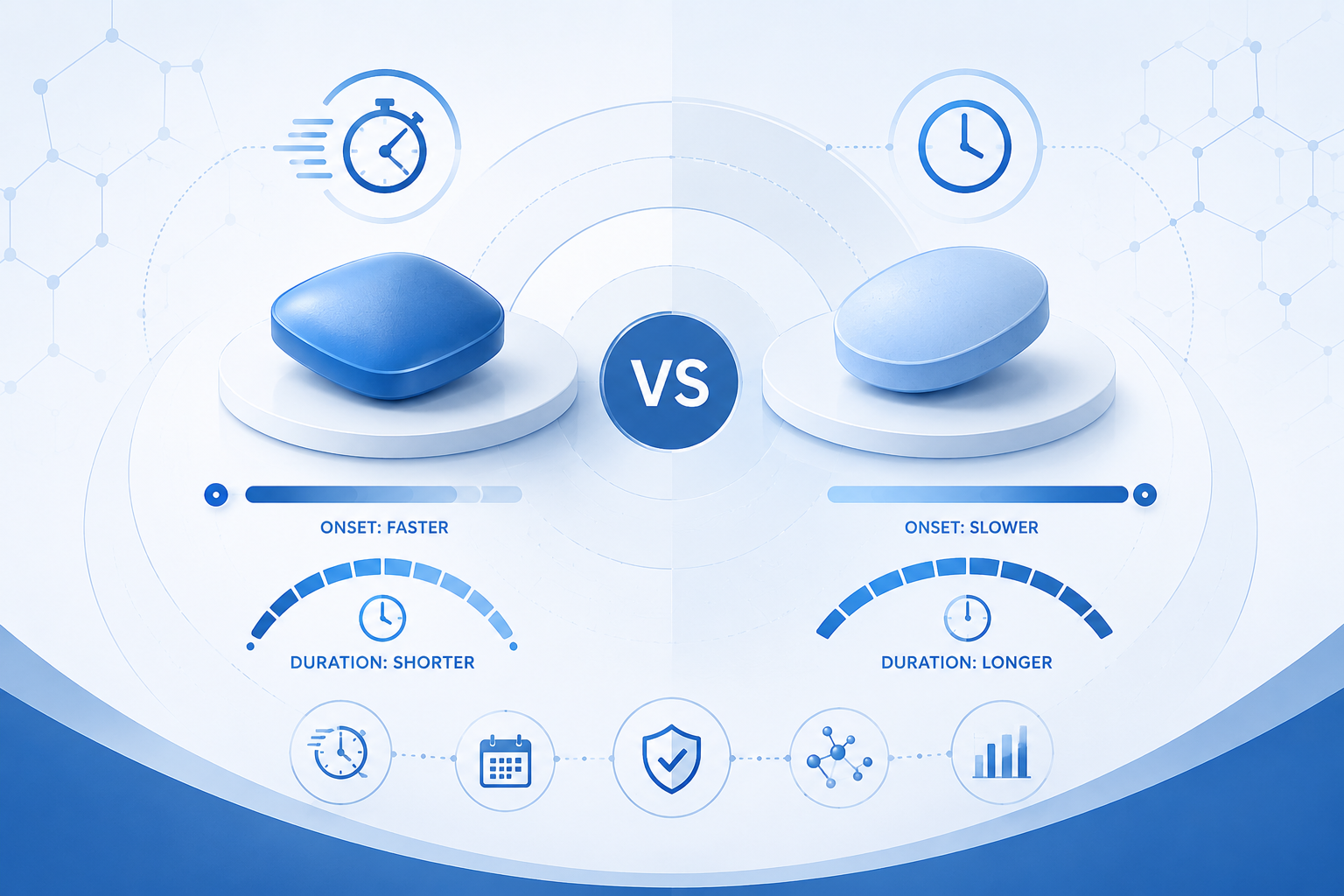
Sildenafil and tadalafil are the two most widely used PDE5 inhibitors, each offering a distinct balance between onset speed and duration. Sildenafil typically provides a faster initial response, making timing guidance in Onset & Duration especially important, while tadalafil is known for its prolonged effect that supports both daily and on‑demand regimens. Differences in food sensitivity, peak windows, and practical timing strategies are explored in Timing Optimization, helping users understand how each medication behaves in real‑world conditions. For individualized therapeutic planning, review structured options in Dose Selection.
Sildenafil and tadalafil are both selective PDE5 inhibitors that enhance erectile function by improving nitric‑oxide–mediated vasodilation within penile tissue. Their mechanistic similarity means each follows predictable absorption and distribution patterns, further detailed in Pharmacokinetics. However, real‑world use differs substantially because their onset and duration profiles are not interchangeable. Sildenafil generally produces a faster initial response but remains sensitive to high‑fat meals, which can delay absorption and reduce peak intensity. Tadalafil, in contrast, offers a slower onset but an extended duration that supports spontaneous sexual activity over a prolonged window.
These pharmacological distinctions shape how patients choose between on‑demand and daily regimens. Sildenafil is often preferred by individuals who want a rapid, event‑driven effect and can plan around timing and food interactions. Tadalafil’s long half‑life enables once‑daily micro‑dosing or flexible on‑demand use, making it suitable for men seeking consistent readiness without strict scheduling. Ultimately, selection depends on lifestyle, timing expectations, sensitivity to meal effects, and the desired balance between predictability and spontaneity.
Sildenafil and tadalafil differ meaningfully in how quickly their effects become noticeable, even though both medications share the same PDE5‑inhibition mechanism. Sildenafil typically activates within 30–60 minutes, offering a familiar event‑driven profile that many users associate with predictable timing. Tadalafil, by contrast, reaches functional plasma levels within 20–40 minutes, yet users often perceive it as slower. This paradox stems from tadalafil’s gradual vascular response: although absorption is faster, the subjective effect builds more smoothly, creating a less abrupt transition into full efficacy. These nuances are explored further in Onset & Duration, where timing expectations are contextualized across different regimens.
Food sensitivity also plays a major role in onset reliability. Sildenafil’s absorption is notably affected by high‑fat meals, which can delay onset and reduce peak intensity. Tadalafil maintains a more stable profile regardless of food intake, making it easier to integrate into spontaneous or flexible schedules. Understanding these onset dynamics helps users anticipate real‑world performance and choose the medication that aligns best with their timing needs.
| Medication | Typical Onset | Food Sensitivity | Notes |
|---|---|---|---|
| Sildenafil | 30–60 min | High | Fatty meals delay onset |
| Tadalafil | 20–40 min | Low | More stable timing |
Duration is the most defining difference between sildenafil and tadalafil, shaping how each medication fits into daily routines and sexual planning. Sildenafil provides a 4–6‑hour activity window, which supports structured, on‑demand use but requires attention to timing. Tadalafil’s duration of 24–36 hours fundamentally changes the strategy: its long half‑life maintains therapeutic levels across an entire day or more, enabling spontaneous activity without the need for precise scheduling. These distinctions are central to timing strategies discussed in Timing Optimization, where users can evaluate how duration influences flexibility and predictability.
Tadalafil’s extended window also reduces pressure around meal timing, social plans, and unexpected delays. Many users describe it as a “weekend pill” because it supports multiple sexual encounters within a single dosing period. Sildenafil, while effective, requires more deliberate coordination, making it ideal for individuals who prefer a shorter, more controlled therapeutic window. Choosing between them often depends on lifestyle, spontaneity preferences, and how much timing structure a user is comfortable managing.
| Medication | Duration | Notes |
|---|---|---|
| Sildenafil | 4–6 hours | Shorter window |
| Tadalafil | 24–36 hours | “Weekend pill” |
Sildenafil and tadalafil demonstrate similar overall effectiveness in improving erectile function, but users often experience meaningful differences in timing reliability and practical performance. Sildenafil’s effectiveness can fluctuate when taken after heavy meals, making timing consistency a key consideration. Tadalafil, with its low food sensitivity and long duration, provides a more stable experience across varied daily conditions. These distinctions influence how users perceive real‑world reliability and are further explored in Maximize Effectiveness, where practical strategies are outlined.
User preference frequently depends on lifestyle and expectations. Individuals who prefer a shorter, more controlled window often choose sildenafil, while those seeking flexibility and reduced planning gravitate toward tadalafil. Both medications perform well clinically, but their differences in timing reliability, food interactions, and flexibility create distinct use cases that guide personalized selection.
| Factor | Sildenafil | Tadalafil |
|---|---|---|
| Timing reliability | Moderate | High |
| Food sensitivity | High | Low |
| Flexibility | Short window | Long window |
Sildenafil and tadalafil share a broadly similar safety profile, but their tolerability patterns differ in ways that influence user experience. Both medications commonly cause headache and mild flushing due to PDE5‑mediated vasodilation, yet tadalafil is more frequently associated with muscle aches. This occurs because tadalafil has measurable activity on PDE11, an enzyme present in skeletal muscle tissue, which can lead to lower‑back or thigh discomfort in some users. Sildenafil, on the other hand, is more likely to produce visual tint or mild color perception changes. This effect is linked to its interaction with retinal PDE6, making visual symptoms a recognizable but typically short‑lived feature of sildenafil use. These nuances are explored further in Side Effects, where broader tolerability patterns are discussed.
In practical terms, most side effects remain mild and transient, but individual sensitivity varies. Users who prioritize minimal muscle discomfort often prefer sildenafil, while those who wish to avoid visual disturbances may lean toward tadalafil. Understanding these tolerability differences helps align medication choice with personal comfort, lifestyle, and expectations regarding predictable day‑to‑day use.
| Side Effect | Sildenafil | Tadalafil |
|---|---|---|
| Headache | Common | Common |
| Flushing | Common | Less common |
| Muscle aches | Rare | More common |
| Visual tint | More common | Rare |
Choosing between sildenafil and tadalafil often comes down to lifestyle, timing expectations, and how structured or flexible a user prefers their regimen to be. Sildenafil fits best for individuals who want a shorter, event‑driven window and are comfortable planning around a 30–60‑minute onset and potential food interactions. Its rapid, concentrated effect makes it suitable for predictable, scheduled encounters where timing precision matters. Tadalafil, by contrast, excels in scenarios requiring flexibility. Its 24–36‑hour duration supports spontaneous activity, reduces pressure around meal timing, and allows users to maintain readiness without repeatedly coordinating doses. These distinctions are further contextualized in Dose Selection, where regimen structure is discussed.
Lifestyle considerations often guide preference: users with irregular schedules or those who value spontaneity tend to favor tadalafil, while individuals who prefer a shorter therapeutic window or want to avoid prolonged pharmacological activity may choose sildenafil. Both medications are effective, but their timing profiles and practical differences create distinct use cases that help match each option to personal habits and expectations.
Sildenafil generally produces a noticeable effect within 30–60 minutes, while tadalafil reaches functional levels in about 20–40 minutes. Despite this, many users perceive tadalafil as slower because its onset feels more gradual and less abrupt. Sildenafil’s faster subjective response makes it suitable for planned, event‑driven use, whereas tadalafil’s smoother buildup supports flexible timing. Both medications require sexual stimulation to work, but their onset profiles create different user experiences.
Tadalafil lasts significantly longer, maintaining effectiveness for 24–36 hours due to its extended half‑life. This prolonged duration allows users to remain ready across an entire day or weekend without repeated dosing. Sildenafil, by contrast, provides a shorter 4–6‑hour window, which is ideal for structured, time‑specific use. The difference in duration is one of the main reasons users choose tadalafil for flexibility and sildenafil for more controlled timing.
No, food affects them differently. Sildenafil is highly sensitive to high‑fat meals, which can delay absorption, reduce peak intensity, and extend the onset window. This makes timing more variable when taken after heavy food. Tadalafil, however, maintains stable absorption regardless of meal type, allowing users to take it with or without food without meaningful changes in performance. This difference is a major factor in real‑world timing reliability.
Both medications share common side effects such as headache and flushing, but each has distinct tolerability patterns. Sildenafil is more likely to cause visual tint or mild color perception changes due to its interaction with retinal enzymes. Tadalafil, on the other hand, more frequently causes muscle aches or lower‑back discomfort because of its activity on PDE11. These differences are usually mild but can influence user preference and comfort.
Tadalafil is generally preferred for flexible timing because its long 24–36‑hour duration supports spontaneous activity without the need for precise scheduling. Users can take it once and remain ready across an extended period, making it ideal for unpredictable routines or multiple encounters. Its low sensitivity to food also contributes to consistent performance. This flexibility is one of tadalafil’s defining advantages.
Sildenafil is often preferred for planned timing because it provides a shorter, more concentrated window of action. Users who want a predictable effect for a specific event can coordinate dosing around its 30–60‑minute onset. Although food can affect absorption, careful timing helps maintain reliability. This makes sildenafil suitable for individuals who prefer structured, event‑driven use rather than extended readiness.
People switch between these medications to find the timing, tolerability, and lifestyle fit that works best for them. Some prefer sildenafil’s faster, more concentrated effect but later seek tadalafil’s extended flexibility. Others start with tadalafil and switch to sildenafil to avoid prolonged activity or muscle aches. Differences in food sensitivity, onset expectations, and daily routines all influence switching decisions as users refine what feels most comfortable and reliable.