Erectile Dysfunction • PDE5 Inhibitor

Sildenafil Brand Comparison: Quality, Stability & Real‑World Differences

Sildenafil brands differ more than patients expect, largely due to variations in brand quality, generic formulation, and manufacturing standards. Even when the active ingredient is identical, GMP‑level production, dissolution speed, excipient profiles, and long‑term stability shape how reliably a tablet performs. Indian manufacturers such as Ajanta, Sunrise, Centurion, Healing Pharma, and Ranbaxy illustrate this spectrum: some deliver highly consistent batches with predictable absorption, while others show noticeable variability in onset and tolerability. These differences matter for men seeking stable pharmacokinetics and reproducible clinical effect. Understanding how brand formulation impacts real‑world performance helps clarify why certain products feel smoother, faster, or more dependable. For a deeper comparison of branded Viagra and generics, explore the Sildenafil vs Viagra section.

Why Sildenafil Brands Differ
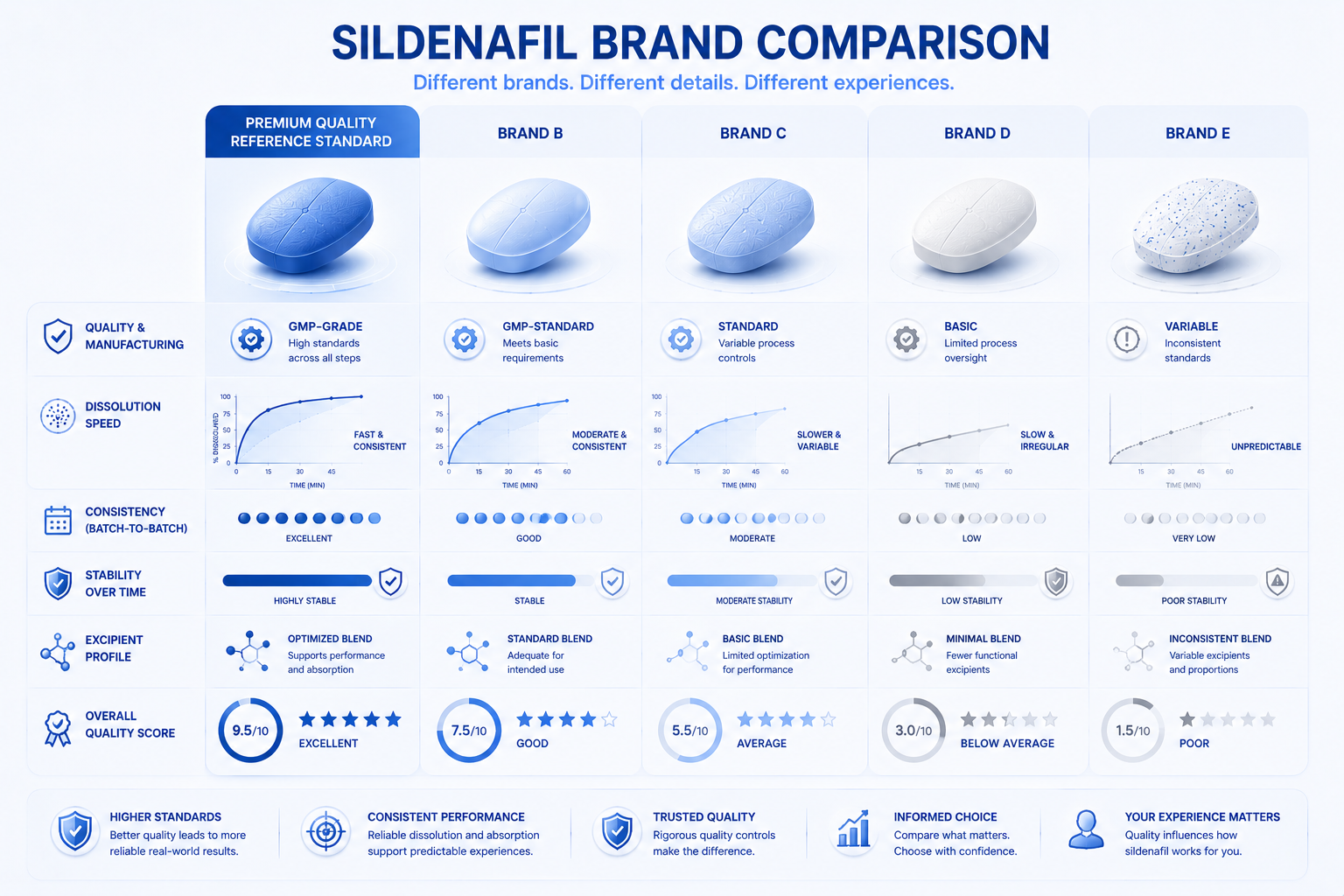
Sildenafil Brand Comparison

Although all sildenafil products contain the same active ingredient, real‑world performance varies significantly because excipients, tablet coating, and dissolution characteristics differ between manufacturers. These formulation variables influence how quickly the drug disintegrates, how efficiently it dissolves in gastric fluid, and how consistently it reaches systemic circulation. Even small changes in binder type, lubricant concentration, or coating thickness can alter onset reliability and tolerability. Understanding these formulation nuances is essential when evaluating overall brand quality.

Manufacturing standards further amplify these differences. GMP‑certified production ensures tight control over granulation, compression force, moisture levels, and stability testing. Non‑GMP or loosely regulated facilities may produce batches with variable hardness, inconsistent dissolution profiles, or reduced shelf stability. This is why Indian sildenafil brands show a wide spectrum of consistency: companies like Ajanta and Sunrise typically maintain strong quality control, while smaller manufacturers may exhibit noticeable variability in pharmacokinetics and patient experience.

Ultimately, brand selection affects onset speed, smoothness of effect, gastrointestinal tolerability, and long‑term stability. Two tablets may contain identical sildenafil citrate, yet differ markedly in how predictably they work. Evaluating excipient composition, dissolution behavior, and manufacturing rigor helps explain why some brands feel faster, steadier, or more dependable than others.

Indian GMP Brands Overview

Indian sildenafil manufacturers dominate the global generics market because they combine large‑scale production capacity with competitive pricing and increasingly rigorous GMP compliance. Brands such as Ajanta, Sunrise, Centurion, Healing Pharma, and Ranbaxy illustrate how manufacturing standards directly shape real‑world consistency. GMP‑certified facilities maintain strict control over granulation, compression force, dissolution testing, and stability validation, resulting in predictable pharmacokinetics and smoother patient experience. Non‑GMP or partially regulated plants may produce batches with variable hardness, inconsistent disintegration, or reduced shelf stability, which can translate into noticeable differences in onset and tolerability.

Ajanta and Sunrise are widely regarded for strong quality control and reliable dissolution behavior, making them popular export brands. Healing Pharma and Ranbaxy benefit from modern equipment and legacy pharmaceutical expertise, often delivering high stability and reproducible onset. Centurion, while a major manufacturer, shows more brand‑dependent variability due to differences across product lines. These distinctions explain why patients may perceive certain Indian brands as faster, smoother, or more dependable despite identical active ingredient content.

Brand GMP Status Dissolution Reliability Notes
Ajanta High Consistent Strong QC reputation
Sunrise High Moderate–high Popular export brand
Centurion Moderate Moderate Brand‑dependent variability
Healing Pharma High High Modern manufacturing
Ranbaxy High High Legacy pharma giant

Brand Differences: Dissolution & Onset

Dissolution speed is one of the most influential factors determining how quickly sildenafil begins to work. Excipients such as disintegrants, binders, and lubricants control how rapidly a tablet breaks apart in gastric fluid. Brands using high‑quality, well‑balanced excipient systems typically dissolve faster, producing a smoother and more predictable onset. Slower‑dissolving tablets often contain denser coatings, lower‑grade binders, or inconsistent compression force, which can delay absorption and create variability between doses.

These differences explain why some generics feel fast and reliable while others show noticeable delays. Premium GMP brands usually achieve rapid disintegration and stable onset, whereas standard generics may vary depending on batch quality. Low‑cost generics, especially those with minimal coating control, can produce inconsistent timing. Understanding dissolution behavior helps optimize practical use, especially for patients adjusting their intake strategy or exploring timing optimization for more predictable results.

Brand Type Dissolution Speed Onset Reliability Notes
Premium GMP Fast High Consistent excipients
Standard generic Moderate Moderate Brand‑dependent
Low‑cost generic Variable Low Inconsistent coating

Stability Differences Across Brands

Stability is a critical but often overlooked factor influencing sildenafil’s real‑world performance. Tablet coating quality determines how well the active ingredient is protected from moisture, oxidation, and mechanical stress. High‑stability brands use dense, uniform coatings that preserve potency over time, while low‑stability products may degrade faster, especially in humid climates. Packaging also plays a major role: foil‑sealed blisters with strong barrier properties maintain integrity far better than basic plastic strips.

Humidity and temperature resistance vary widely across manufacturers. GMP‑certified brands typically conduct accelerated stability testing to ensure tablets remain effective throughout their shelf life. Lower‑cost generics may skip or reduce these tests, resulting in shorter stability windows and greater variability in onset and tolerability as tablets age. Evaluating coating strength, packaging quality, and environmental resistance provides a clearer picture of overall brand quality and long‑term reliability.

Factor High‑Stability Brand Low‑Stability Brand
Coating Strong Weak
Packaging Protective Basic
Humidity resistance High Low
Shelf life Long Shorter

Real‑World Brand Performance

Real‑world user feedback consistently highlights meaningful differences between major Indian sildenafil brands, even though all contain the same active ingredient. Ajanta and Healing Pharma are frequently described as “stronger” because their GMP‑level manufacturing produces tablets with highly predictable dissolution and stable onset. Users often report smoother vascular response and fewer timing surprises, which aligns with their modern quality‑control systems and tighter batch uniformity. Sunrise, while reliable and widely exported, is generally viewed as solid but not premium—its dissolution profile is consistent, yet not as fast or polished as top‑tier GMP manufacturers.

Centurion shows the widest variability, largely due to differences across product lines and occasional batch‑to‑batch fluctuations. Some batches dissolve quickly and perform well, while others feel slower or less consistent. Ranbaxy, backed by legacy pharmaceutical expertise, typically delivers high stability and dependable onset. Users evaluate brands based on onset speed, smoothness of effect, tolerability, and how consistently a tablet performs across multiple doses. These real‑world impressions help clarify why certain brands become preferred options in everyday real‑world use.

Brand Real‑World Consistency User Notes
Ajanta High Strong, predictable onset
Healing Pharma High Modern QC, stable results
Sunrise Moderate–high Reliable but not premium
Centurion Moderate Batch variability
Ranbaxy High Strong pharma heritage

When Brand Differences Matter Clinically

Although sildenafil brands share the same active ingredient, clinical relevance emerges when onset variability becomes severe or when tablets show signs of poor manufacturing quality. Patients may notice unpredictable timing—some doses activating quickly, others taking significantly longer. This inconsistency often reflects differences in dissolution behavior, coating thickness, or excipient quality. Unusual side effects, such as stronger flushing, headaches, or gastrointestinal discomfort, can also indicate formulation‑specific issues rather than true pharmacological differences.

Physical tablet defects matter as well. Crumbling edges, powdery surfaces, or discoloration suggest inadequate coating, moisture exposure, or suboptimal packaging. These issues can reduce potency, shorten shelf life, and increase variability in onset. When such problems occur repeatedly, switching to a more stable brand becomes clinically reasonable—especially for patients who rely on predictable timing or experience sensitivity to excipient changes.

Evaluating these signals helps determine when a brand transition is appropriate. Patients experiencing inconsistent onset, unexpected side effects, or visible tablet degradation should review safety considerations in Warnings and assess formulation‑related tolerability in Side Effects. In many cases, selecting a higher‑stability GMP brand restores predictable performance and improves overall treatment reliability.

Frequently Asked Questions

Sildenafil brands differ because manufacturers use different excipients, coating materials, compression forces, and dissolution standards. Even though the active ingredient is identical, variations in granulation quality, moisture control, and stability testing can lead to noticeable differences in onset speed, tolerability, and consistency. GMP‑certified facilities typically maintain tighter quality control, while non‑GMP plants may produce batches with more variability. These formulation and manufacturing factors explain why users often perceive brands differently.

Ajanta, Healing Pharma, and Ranbaxy are generally considered the most consistent due to strong manufacturing standards and reliable dissolution profiles. These companies invest in modern equipment, stability testing, and strict quality‑control procedures that help ensure predictable onset and uniform tablet performance. Sunrise also performs well, though it is usually viewed as reliable rather than premium. Centurion can be effective, but users often report more batch‑to‑batch variability compared to higher‑tier GMP manufacturers.

GMP brands often feel more reliable because they follow strict manufacturing standards that improve dissolution consistency, tablet stability, and batch uniformity. This does not mean the active ingredient is stronger, but rather that the formulation behaves more predictably in real‑world use. Faster disintegration, stable coating, and controlled moisture levels help reduce timing surprises and minimize variability between doses. As a result, many users perceive GMP brands as smoother and more dependable overall.

Dissolution varies because manufacturers use different excipients, binders, lubricants, and coating thicknesses. These components determine how quickly a tablet breaks apart in gastric fluid and how efficiently the active ingredient becomes available for absorption. Premium brands typically use high‑quality disintegrants and uniform compression, resulting in faster and more predictable dissolution. Lower‑cost generics may rely on simpler formulations, which can slow disintegration and create timing variability between doses.

Brand quality can be evaluated by looking at manufacturing standards, tablet appearance, dissolution consistency, and real‑world user feedback. GMP certification is a strong indicator of reliable production practices. Tablets should have uniform coating, no crumbling edges, and stable color. Consistent onset across multiple doses also suggests good formulation control. Many users compare brands based on smoothness of effect, tolerability, and how predictable the timing feels in everyday use.

Some generics feel stronger because their excipient profile or dissolution speed leads to faster absorption and a more noticeable early effect. This does not mean the dose is higher; rather, the formulation may deliver the active ingredient more efficiently. Brands with high‑quality disintegrants and uniform coating often produce a smoother vascular response, while slower‑dissolving tablets may feel weaker or less consistent. User perception is strongly influenced by onset reliability and overall tolerability.

Switching brands may be appropriate when onset becomes unpredictable, tablets show physical defects, or side effects appear unusually strong compared to previous experiences. Variability in timing, crumbling edges, discoloration, or inconsistent tolerability can indicate formulation or stability issues. Users who rely on predictable onset often benefit from choosing a more stable GMP brand. Monitoring performance across several doses helps determine whether a change is necessary for more reliable results.