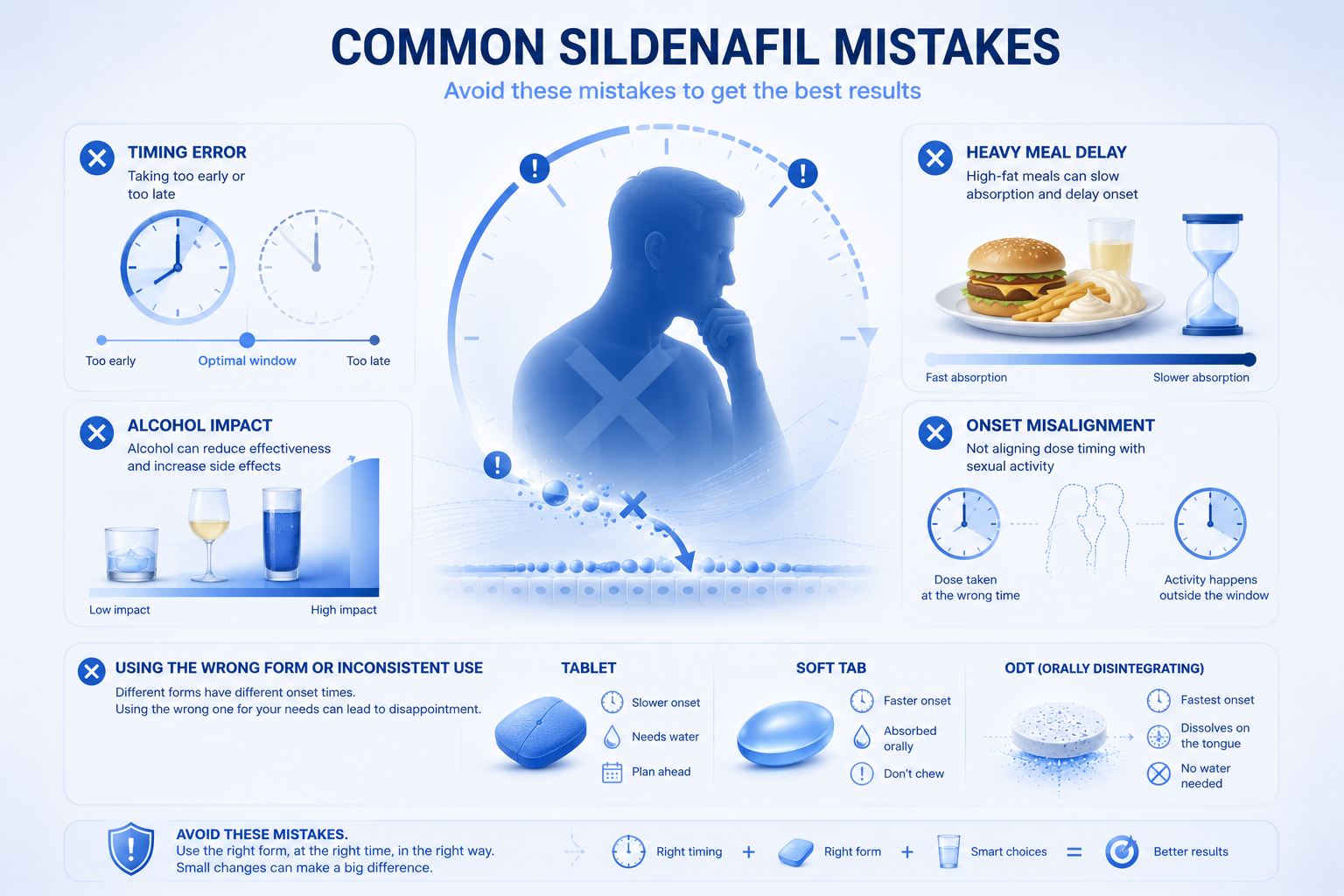
Many men experience reduced sildenafil effectiveness not because the medication fails, but because avoidable mistakes interfere with its pharmacokinetic window. Timing errors are the most frequent — taking the dose too early or too late can shift onset away from the moment sexual activity begins, a problem explored further in Timing Optimization. Food‑related mistakes, especially dosing after heavy meals, slow absorption and push onset beyond the expected range, as detailed in Food Interactions. Alcohol overuse weakens vascular responsiveness, while misuse of different forms (tablets, soft tabs, ODT) leads to unpredictable onset. Understanding these patterns helps users achieve more reliable results, supported by practical guidance in Maximize Effectiveness.
Sildenafil’s effectiveness depends on a precise sequence of absorption, onset, peak activity, and duration. When this sequence is disrupted, the medication may still “work,” but not at its optimal level. The drug’s underlying pharmacokinetics determine how quickly it enters the bloodstream and reaches the concentration needed for strong erectile response. Any factor that slows absorption or shifts onset away from planned sexual activity reduces the perceived effect.
Timing mistakes are the most common. Taking sildenafil too early can cause its effect to fade before stimulation occurs, while taking it too late means missing the peak window entirely. Food‑related errors, especially dosing after heavy or high‑fat meals, delay gastric emptying and push onset far beyond the expected range. Alcohol further complicates the response by weakening vascular signaling and reducing erection quality, even when the drug reaches adequate plasma levels.
Form‑related mistakes also matter. Tablets rely solely on gastrointestinal absorption, making them more sensitive to food delays, while soft tabs and ODT forms offer faster, more predictable onset. Users who misunderstand these differences often assume the medication is ineffective when the real issue is misaligned onset. Ultimately, sildenafil’s effectiveness is not binary — it is a spectrum shaped by timing, diet, alcohol intake, and formulation choice, all of which determine whether the drug works adequately or optimally.
Food‑related mistakes are among the most common reasons sildenafil feels slower or less effective. The biggest issue is taking the medication immediately after a heavy, high‑fat meal. Such meals slow gastric emptying and delay absorption, pushing onset far beyond the expected window. Many users underestimate how strongly meal composition affects timing, which is why understanding these patterns is essential. More detailed dietary guidance is available in the Food Interactions section.
Light meals are often misunderstood as “no impact,” but they still introduce minor delays. While these delays are usually small, they matter when precise onset alignment is needed. Another frequently overlooked factor is grapefruit consumption. Grapefruit inhibits CYP3A4, the enzyme responsible for metabolizing sildenafil, which can increase circulating drug levels and heighten sensitivity to side effects. Recognizing these interactions helps users plan dosing more effectively and avoid unnecessary variability.
Practical timing adjustments make a significant difference. Waiting 1–2 hours after a heavy meal or 30–45 minutes after a light meal helps restore predictable onset. Avoiding grapefruit around dosing windows further stabilizes the response. Together, these strategies ensure sildenafil reaches its active phase efficiently and consistently.
| Mistake | Impact | Notes |
|---|---|---|
| Heavy meal before dosing | Delayed onset | Food-sensitive |
| Light meal misinterpreted | Minor delay | Timing still matters |
| Grapefruit consumption | Increased levels | CYP3A4 inhibition |
Timing mistakes are the leading cause of inconsistent sildenafil results. Taking the medication too early often means the effect begins to fade before sexual activity, especially given the typical 4–6‑hour duration. Conversely, taking it too late results in missing the peak window entirely, making the drug feel weaker even though it is working pharmacologically. These issues are explored further in the Timing Optimization section.
Many users also misinterpret normal onset variability. Sildenafil does not activate at the exact same minute every time; small fluctuations are normal. Misreading these variations as “ineffectiveness” leads to unnecessary dose changes or frustration. Another common mistake is ignoring formulation differences. Tablets rely on GI absorption and are more sensitive to food delays, while soft tabs and ODT forms activate faster and more predictably. Choosing the wrong form for one’s timing needs creates avoidable inconsistency.
Correcting these timing mistakes restores predictable onset. Aligning dosing with planned activity, understanding each form’s onset profile, and accounting for normal variability ensures sildenafil reaches its active phase at the right moment.
| Mistake | Impact | Notes |
|---|---|---|
| Taking too early | Effect may fade | Duration 4–6 hours |
| Taking too late | Missed peak | Peak window matters |
| Ignoring form differences | Unpredictable timing | ODT fastest |
Alcohol is a major contributor to reduced sildenafil effectiveness. Heavy drinking weakens vascular responsiveness, making erections harder to achieve even when the drug reaches adequate plasma levels. Alcohol also destabilizes blood pressure, increasing the likelihood of dizziness or lightheadedness during sildenafil’s active phase. More detailed guidance is available in the Alcohol section.
Combining alcohol with fatty food creates a “double delay” effect: food slows absorption while alcohol blunts the vascular response, making onset significantly less predictable. Another mistake is pairing alcohol with higher sildenafil doses, which increases the risk of side effects such as dizziness, flushing, or blood‑pressure drops. These interactions do not mean sildenafil stops working, but they reduce its peak performance and reliability.
Practical strategies include limiting alcohol intake around dosing, avoiding heavy meals when drinking, and being aware of how alcohol affects individual responsiveness. These adjustments help maintain sildenafil’s therapeutic window and reduce variability in onset and erection quality.
| Mistake | Impact | Notes |
|---|---|---|
| Heavy drinking | Reduced effectiveness | BP instability |
| Alcohol + fatty food | Strong delay | Double interaction |
| Alcohol + high dose | More side effects | Dizziness risk |
Many users underestimate how strongly sildenafil’s formulation affects onset, consistency, and overall effectiveness. Tablets, soft tabs, and ODT each rely on different absorption pathways, and misunderstanding these differences often leads to avoidable timing problems. Tablets depend entirely on gastrointestinal absorption, making them more sensitive to food delays and less suitable when precise timing is critical. Soft tabs dissolve partially through buccal absorption, but misuse — such as swallowing them immediately — reduces their predictability. More detailed comparisons are available in the Soft Tabs and ODT sections.
Another common mistake is expecting tablet‑like timing from soft tabs or ODT. These faster forms activate more quickly, and misunderstanding their onset profile can cause users to mistime sexual activity. Ignoring the benefits of buccal absorption also leads to inconsistent results, especially for men who frequently eat before dosing or who need rapid onset. ODT forms provide the fastest and most reliable activation because they bypass most GI variability, yet many users overlook them entirely.
Practical form‑selection guidance involves choosing tablets only when timing is flexible, using soft tabs correctly to leverage buccal absorption, and selecting ODT when maximum timing reliability is needed. Understanding these distinctions ensures sildenafil reaches its active phase consistently and predictably.
| Mistake | Impact | Notes |
|---|---|---|
| Using tablets when timing is critical | Slower onset | Food-sensitive |
| Misusing soft tabs | Unpredictable onset | Buccal absorption matters |
| Ignoring ODT benefits | Missed fastest onset | Most reliable form |
While most sildenafil problems stem from timing, food intake, alcohol use, or formulation errors, certain patterns suggest a deeper issue that requires attention. Severe delays — such as onset consistently taking far longer than expected — may indicate significant interference from meals, alcohol, or gastrointestinal variability. In some cases, users experience no response despite correct timing and proper use, which may point to underlying vascular or hormonal factors rather than a medication‑related problem. Strong side effects triggered by dosing mistakes, including dizziness or blood‑pressure drops, are also warning signs. More details on adverse reactions are available in the Side Effects and Warnings sections.
When these issues occur repeatedly, adjusting timing or switching to a different formulation may help restore predictable onset. Faster forms such as soft tabs or ODT can bypass some GI‑related delays, while more structured timing strategies reduce variability. However, persistent lack of response or escalating side effects may indicate a medical condition that requires professional evaluation. A healthcare provider can help determine whether sildenafil remains appropriate and whether alternative approaches should be considered.
The most common sildenafil mistakes involve timing errors, food‑related delays, alcohol overuse, and misunderstanding differences between tablets, soft tabs, and ODT forms. Taking the dose too close to a heavy meal slows absorption, while mistiming the dose causes onset to miss the intended window. Alcohol weakens vascular responsiveness, making erections harder to achieve. Many users also misinterpret normal onset variability or misuse faster forms, leading to inconsistent results even when the medication itself is working properly.
Fatty meals significantly delay sildenafil’s onset by slowing gastric emptying and reducing the speed at which the medication enters the bloodstream. Although sildenafil still works, the effect may begin much later than expected, which can disrupt planned timing and reduce perceived effectiveness. Heavy meals can push onset well beyond the usual window, while lighter meals cause only minor delays. Allowing enough time after eating helps maintain predictable absorption and a more reliable response.
Timing determines whether sildenafil reaches peak concentration at the moment sexual activity begins. Taking it too early may cause the effect to fade before stimulation occurs, while taking it too late means missing the optimal window entirely. Because onset varies with meal timing, alcohol intake, and formulation choice, aligning the dose with planned activity is essential. Proper timing ensures the medication delivers its strongest and most predictable effect when it is actually needed.
Alcohol can reduce sildenafil’s effectiveness by weakening vascular responsiveness and interfering with the physiological signals needed for a strong erection. Even moderate drinking may make the medication feel less potent, while heavier intake increases the risk of dizziness, blood‑pressure drops, and reduced erection quality. Although sildenafil still activates, alcohol often blunts its peak effect, making the response less reliable and more variable from dose to dose.
Soft tabs can reduce timing mistakes because they dissolve partially through buccal absorption, allowing faster and more predictable onset compared to standard tablets. They are less affected by heavy meals and often activate more consistently. However, they do not eliminate timing errors entirely. Misuse—such as swallowing them immediately—removes their advantage, and users still need to align dosing with planned activity. When used correctly, soft tabs help stabilize onset and reduce variability.
Onset varies between doses because absorption depends on multiple factors, including meal timing, formulation type, alcohol intake, and natural gastrointestinal variability. Even small differences in stomach contents or metabolic rate can shift onset by several minutes. Tablets are especially sensitive to food delays, while soft tabs and ODT forms provide more stable activation. These fluctuations are normal and do not mean the medication is ineffective—only that conditions around dosing influence timing.
Mistakes can be avoided by aligning dosing with planned activity, avoiding heavy meals before taking the medication, limiting alcohol intake, and choosing the right formulation for one’s timing needs. Soft tabs and ODT forms offer faster onset and reduce food‑related delays, while tablets require more careful planning. Understanding normal onset variability and adjusting habits accordingly helps ensure sildenafil reaches its active phase consistently and delivers a more reliable therapeutic response.